 cad-agent.
Supply chain and resource safety
cad-agent depends on Python and npm packages, vendors other people's code into vendor/ and the web kit, and sends
readers to hundreds of outside projects from its catalogue and pages. tools/resource_audit.py checks all of it the
same way every time: known advisories and malicious packages, pins and recorded hashes, vendored files against their
upstream, licences, and links that died, moved or now point somewhere else. Each pull request into dev gets the
offline checks; a weekly run adds the online ones and keeps one issue current. The latest run is in the
supply-chain report, and the cad-supply-chain skill
says what to do with each finding.
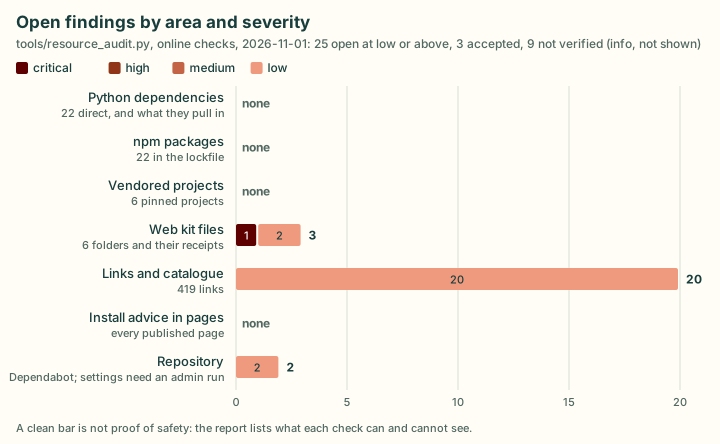
Real output of tools/resource_audit.py, drawn from the committed report of
this repository. A test redraws it from the report's JSON, so the two cannot disagree.
What it checks
| Area | Offline, on every PR (seconds, no network) | Online, weekly or on demand |
|---|---|---|
Python dependencies (pyproject.toml, every extra) |
lower bounds, readable requirements | OSV advisories at the newest release and the lowest one each range allows, and for every transitive package deps.dev resolves; PyPI releases, licences, "inactive" |
npm packages (package-lock.json) |
registry source over HTTPS, sha512 integrity, install scripts, licences, lockfile in step | OSV and npm audit, deprecations |
Vendored projects (vendor/) |
full-commit pins, licence files, reviewed baselines, notices | every file against upstream at the pinned commit (git blob hashes), upstream advisories since the import, archived or moved, Scorecard |
Web kit (src/cadagent/webkit/vendor/) |
every file against the SHA-256 in its receipt; each receipt names its npm tarball and integrity, or "npm": false and each file's URL; the versions of the libraries a file bundles are in that file |
OSV for each library, including DOMPurify and KaTeX inside mermaid.min.js; the tarball against its integrity, and each file against the package's bytes (a patched file must differ, from the file its upstream_sha256 names) |
| Links (catalogue and every published page) | plain HTTP, missing licences, stale records | repository gone, moved, archived or relicensed; dead pages, redirects to another domain, HTTPS downgrades |
| Install advice in pages | installing skills or plugins from a registry, piping a download into a shell, running a package through npx or uvx without a version, pointing at a moving "latest" |
Everything fetched is data: advisory text, package metadata, tarballs and pages are parsed, never run or followed as instructions, and a tarball is read in memory, never unpacked to disk. Before building it we compared what exists (the fold at the end of this page); the report calls those services rather than keeping its own advisory logic.
Where it runs
Drawing diagram…
Scroll sideways to see the full diagram →
Diagram source
flowchart TD
    D["into dev:<br/>a PR or a push"] -->|"whole checkout,<br/>what it adds,<br/>its rows"| G["CI's supply-chain job<br/>offline, not required"]
    M["into main: a release<br/>PR or the push after it"] -->|"whole checkout<br/>only"| G
    classDef here fill:#fffdf5,stroke:#173d3c,color:#173d3c
    classDef near fill:#eef1e4,stroke:#6f8a80,color:#173d3c
    class G here
    class D,M near
What a change adds is judged where new items enter the project, on PRs and pushes into dev: each added dependency,
vendored file or catalogue entry needs its row in the PR description, and none may have a medium or worse finding. A
release PR into main carries items that went through that gate in their own PRs. The job warns rather than blocks,
so a red result there was the reviewer's call, and items from before the job existed never went through it. Compared
with main, "what it adds" would be everything since the last release, which no release PR can describe, so it and
the push after it get the whole-checkout check alone: no high or critical finding anywhere.
The weekly run
Drawing diagram…
Scroll sideways to see the full diagram →
Diagram source
flowchart TD
    W["weekly schedule,<br/>or a run by hand"] --> O["report job: online checks,<br/>read-only token"]
    O -->|"the report,<br/>as an artifact"| I["issue job: one tracking<br/>issue, kept current"]
    classDef here fill:#fffdf5,stroke:#173d3c,color:#173d3c
    classDef near fill:#eef1e4,stroke:#6f8a80,color:#173d3c
    classDef out fill:#ffe1cc,stroke:#bd3a12,color:#173d3c
    class O here
    class W near
    class I out
The online checks gate nothing. The job that reads third-party answers holds no write permission; the job that may write issues reads only the report. A service that does not answer is reported as "not verified", and the issue keeps its earlier findings open as "not re-checked" rather than counting them as fixed.
Run it
python3 tools/resource_audit.py report                               # the offline checks, as CI runs them
python3 tools/resource_audit.py rows --base origin/dev --online       # the rows to paste under "Supply chain"
python3 tools/resource_audit.py gate --base origin/dev --into dev --pr-body-file body.md   # CI's check, locally
python3 tools/resource_audit.py report --online --json research/security-report.json \
    --md research/security-report.md --svg docs/img/supply-chain/findings.svg   # refresh the committed report
python3 tools/resource_audit.py render                                # re-draw the page and figure from its JSON
Run the refresh from a checkout with nothing uncommitted: the report records the revision it read and says so when
the tree had changes. Repository settings (secret scanning, Dependabot alerts) need admin rights, so only the owner's
run with --repo Valpatel/cad-agent sees them.
Making it required (owner)
The supply-chain job is not a required check: a failure warns and does not block. To make it one, the owner adds the
check named supply-chain to the required checks of dev; on main it would only repeat the whole-checkout check. If
the repository's Actions event policy lists events per workflow file, .github/workflows/supply-chain.yml needs
schedule and workflow_dispatch. Agents do not change these settings (#153).
Limits. A clean report is not proof of safety: what it cannot see
- Advisory databases only know what has been reported.
- Licences are matched by keyword from licence files and registry metadata, not reviewed by a lawyer.
- Link checks see status codes and redirects, not content: a parked or replaced page that answers 200 passes, and domain expiry is not checked. GitHub links are checked per repository, not per file.
- Python ranges are checked at their newest and lowest releases; transitive packages at the versions deps.dev resolves, not the ones an existing environment holds.
- Libraries bundled inside a vendored file are checked at the versions its receipt records; whether the bundling library reaches the affected code is not assessed.
- The CI job runs the PR's own copy of the tool and of
research/security-accepted.yaml: it keeps honest work honest, and a reviewer reads changes to those files.
What we looked at before building it, and what we adopted
- OSV.dev (adopted): the advisory database behind pip-audit and osv-scanner, with the OpenSSF
malicious-packages feed (
MAL-ids). The report asks its batch API directly. - osv-scanner (not adopted): it reads lockfiles, and our Python side is
version ranges in
pyproject.toml, not a lockfile. It would add a Go binary for what one OSV call does. - pip-audit (not adopted): it resolves by installing into a temporary
environment, so covering every extra means installing CadQuery, VTK and gmsh; its OSV backend is the source used
here anyway.
--installedchecks the installed versions of our direct dependencies only. npm audit --package-lock-only(adopted): the npm registry's own advisories for the lockfile, no install.- Open Source Insights (deps.dev) (adopted): resolved dependency graphs, for the direct-plus-transitive counts and the transitive packages OSV is asked about.
- OpenSSF Scorecard (adopted): repository hygiene scores, read from its API.
- lychee (ideas adopted): fall back from HEAD to GET, and treat 403 and 429 as not verified rather than broken. Its binary is not needed for a few hundred links.
- GitHub's repository API (adopted): archived, deleted, renamed and relicensed repositories, the vendored trees at their pinned commits, published repository advisories.